
I learned storytelling from many different sources. There was the influence of my Irish heritage, which I received through my father’s mother. There was my father himself, a seasoned raconteur and humorist. There’s the whole Southern storytelling tradition I was steeped in growing up.
One of my chief early influences was my grandfather, Ivan Morgan Hunter. He and my grandmother lived in a small, tumbledown house on the banks of the Cherry River in Richwood, West Virginia. Richwood was built on typical West Virginia “bottom land,” where flowing water flattens out the topography between mountains and creates a flat space on which to build. In its heyday, when a lumber mill, a tannery and a paper mill were in operation in the city, Richwood styled itself as “the hard wood capital of America.” Except for the lumber mill, these industries had moved out by the late 1950s and early 1960s when I traveled there with my parents.
 Ivan Morgan Hunter as a young man
My grandparents’ house was actually built out over the riverbank, and was so close to the river that when you looked out of the windows on the river side, you saw the water directly below. The Cherry was a classic West Virginia river: very shallow–you wouldn’t get your knees wet wading in it–and rock strewn. When the river flooded, as it did occasionally, it would flow under the house and undermine the supports. One time in the 1950s, my grandfather injured his eye shoring up the underside of the house after a deluge.
There were several things that intrigued my childish mind about the house. It was a small house, only two bedrooms, a living room, a dining room and kitchen. There was a screened porch on the river side, where you could sit in a swing and watch the water flow. When we stayed there, I would sleep in the second bedroom. The street (“Riverside Drive”) just outside the window was actually above the level of the bedroom, because of the steep pitch of the hillside next to the house. I used to be lulled to sleep by the sound of cars going by “above” me on the street, and by the unceasing low hiss of the flowing river.
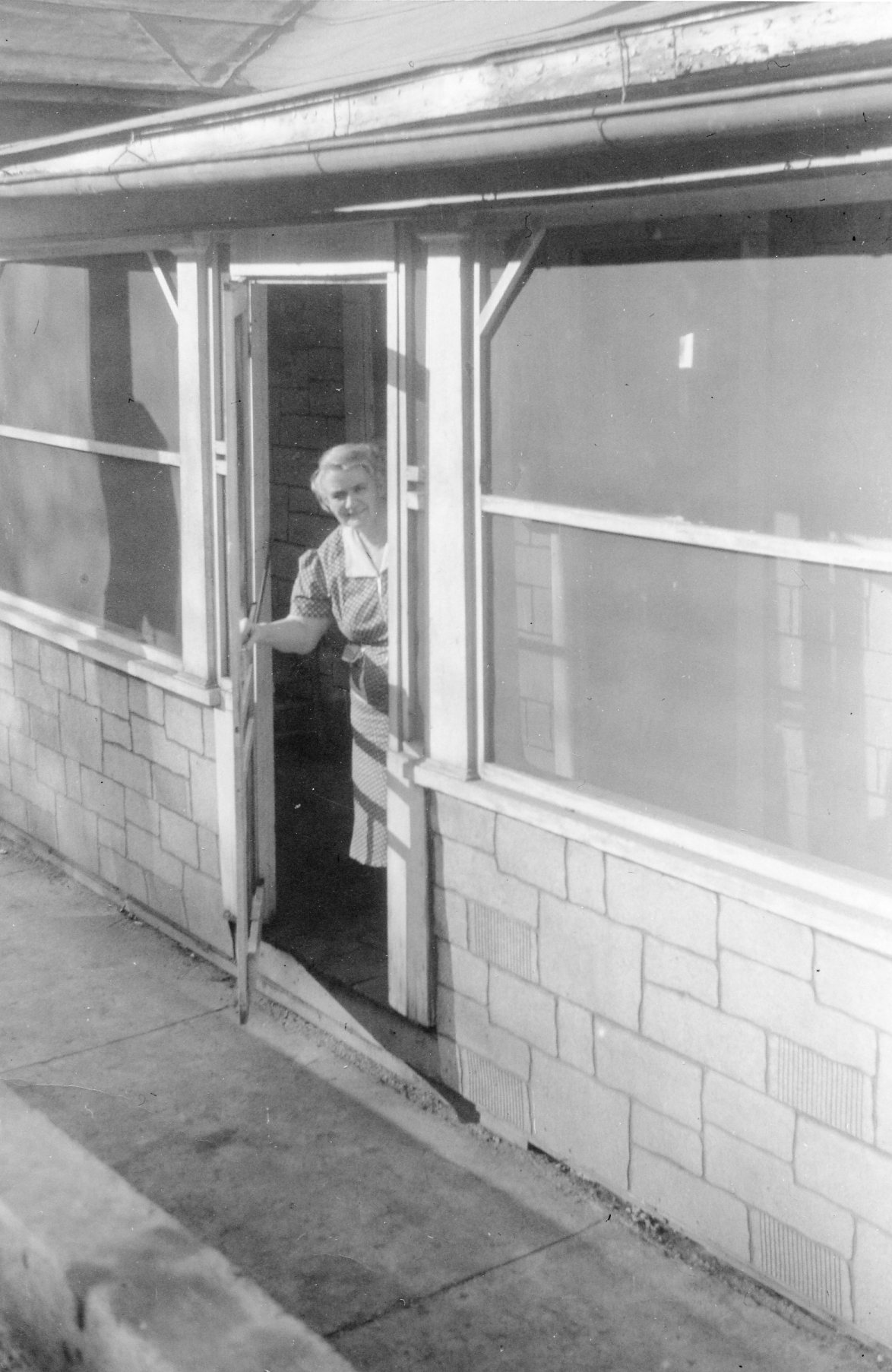 My grandmother, “Aunt Tet,” on the front porch of her house. She was housebound with severe arthritis, and so this was the outer boundary of her world. The unoccupied house fell in on the street side in 2010 and was removed by the city.
My grandfather, Ivan Morgan, had been quite handsome as a young man, and in his seventies and eighties, when I knew him, he was still quite imposing. He had grown up on a farm in rural Augusta County, Virginia. Family lore has it that a vacillating fiancée had called off the wedding ceremony one too many times, and in response, he headed over the mountains–tantamount to disappearing in those days. He landed in a lumber camp near Richwood run by Patrick “P.J.” Norton, whose large family included many attractive daughters, one of whom, Teresa, became his bride on October 1, 1915.
 The Cherry floods Oakford Ave circa 1915. The couple in the jalopy may be my grandfather and grandmother; I’ve never been able to confirm this.
Although he had often worked outdoors, in his later years, he didn’t go out much–just to the corner store to get his cigarettes, or to the Moose Club to get the occasional shot of whiskey.
I remember him sitting in his favorite easy chair–nothing grand, by today’s standards, but perfect for him: comfortably padded, it rocked, allowing him to get out of the chair by pitching himself back and forth until he had enough “altitude” to stand.
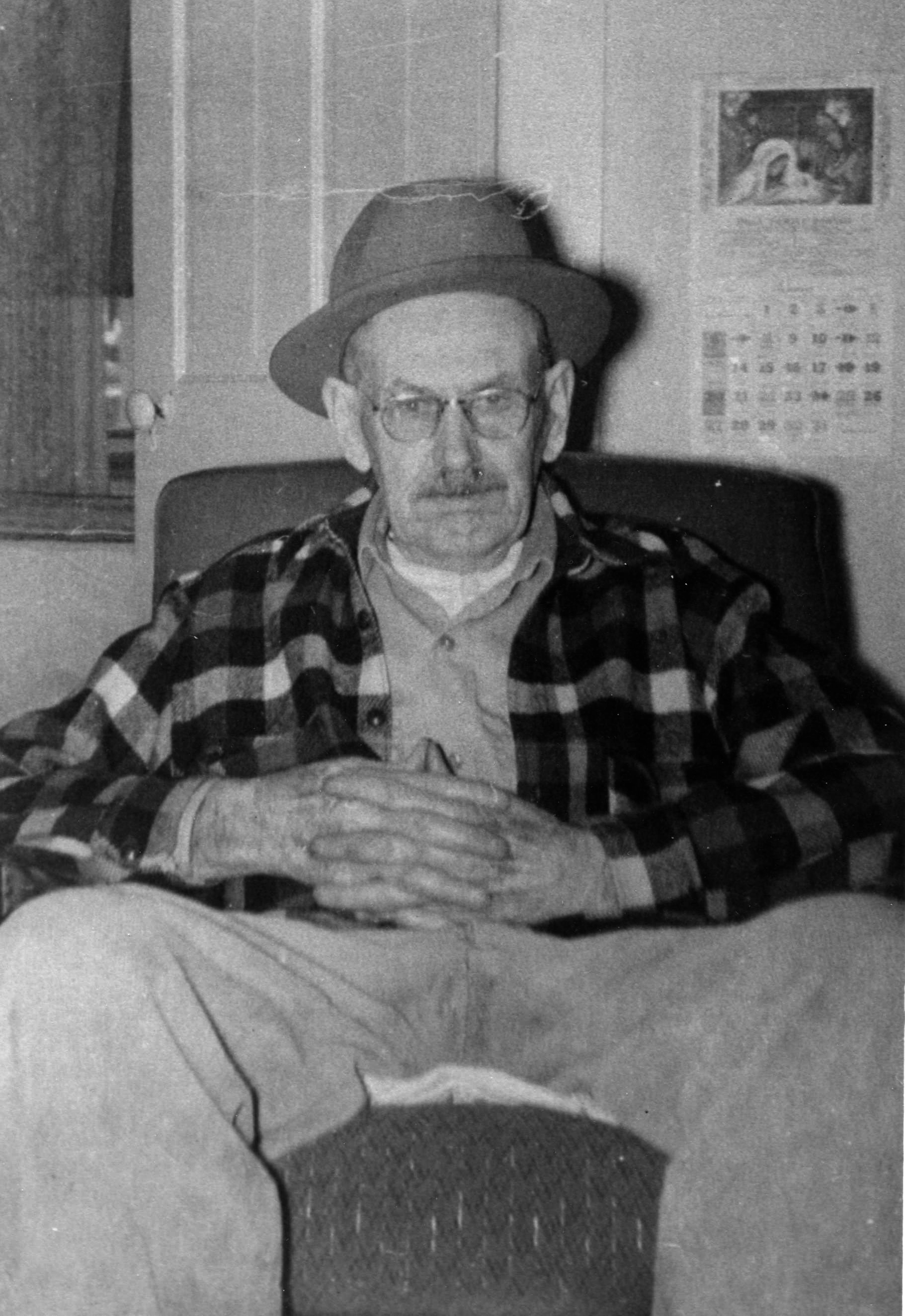 Grandfather Hunter in his favorite chair
My grandfather had only been in school through the eighth grade, but he never seemed uneducated. He taught himself by reading, and there were many volumes of classics packed away in the “junk room” in the back of the house. He could recite long poems from memory. When I knew him, he mainly read the Charleston Gazette, which he would pore over using a large magnifying glass he kept on a wicker side table next to his chair.
The living room was sparely furnished. There was a sofa–they found one that was rather high so my grandmother, who was crippled with arthritis, could get in and out of it easily. There was a Philco TV, bought for my grandparents by the community. When I first started going there, there was a pot-bellied stove and coal scuttle that provided heat in winter, although that was eventually replaced by a gas stove. The outer rooms got cold.
There was a big, dark wood sideboard, a remnant of more prosperous times, which displayed mostly family pictures. My grandmother had a picture of the pope, Pius XII, in one of those dual perspective images that made it appear the pope’s arm moved in blessing you if you wagged the picture from side to side. Grandma and grandpa Hunter with grandson Robert Perry Morgan. Note the palm frond from Palm Sunday draped over the picture in the upper left and the sideboard with family photos in the background.
When we visited, my father often went off visiting his friends in town, leaving my mother and me with Ivan and “Tet,” as my grandmother was universally known (a pet name derived from her given name, Teresa). I would spend many hours sitting across from him, as he sat ensconced in his favorite chair and related experiences drawn from his working life, which included road surveying and fire spotting for the forest service. For some period, he was even a manager at the tannery. It was the fire service job–the last he held–that provided most of the material for his story telling.
In this job, he spent his days in a fire tower, high atop Manning Knob, up the mountain from Richwood. He watched for the telltale smoke in the forested expanse that indicated a fire. He spent his nights in a small cabin at the base of the tower. He walked into town once a week to get his groceries, seven miles each way. This solitary life gave him a lot of time to reflect on his experiences.
 The fire tower and cabin on Manning Knob. The tower was eventually torn down, and the cabin was moved about a quarter mile away across the road.
This reflection came out in his stories. They were not dramatic–they were often just brief vignettes or descriptions of experiences he’d had, or events or people he’d heard about. He told of things like a chestnut sapling he’d tried to rescue and a bear he’d encountered in the woods. One time he recited the entire watershed of the Cherry. He told of a man who froze to death in the woods; he told of a worker at the tannery who was operating a large overhead slicing machine that moved up and down to cut the leather into squares, who lost his forearms when he reached in to straighten the hides. He spoke with pride of a spring he had built near his fire tower.
The stories usually didn’t have any particular point, although there was often an implicit lesson. The man who froze to death, who had been found sitting against a tree, shouldn’t have gone out hunting in such cold weather. The story of the sapling was about the time he found new shoots growing out of the stump of a chestnut tree that had been killed by the blight. He thought it would help the shoots to grow if he cleared the underbrush away from them, but it actually just exposed them, and they died. Shouldn’t have done that.
Sitting there, I absorbed the arc of narrative–how to choose the story elements for maximum effect; what must be included, and in what order, so the listener will understand the story; how to add telling details to draw in the listener; how to wrap it all up in a conclusion that conveyed the import of what had just been heard.
This ability to create a compelling narrative is something I use every day in my professional life, when I write a news release or the script for a documentary. Some of the most enduring and important aspects of my own education happened early on, in that house on the banks of the Cherry.
–Joe Hunter (grandson)

 Hunter's Window
Now we see where the story telling comes from. Without TV and the internet, they had to find their own source of entertainment. You are a patron of the art of storytelling by keeping it going through the distractions.
Grandfather story beautifully written! Awesome! I am proud of my brother!
The new Ernest Hemingway.
Joe, Wonderful story! Can you tell it in front of the fireplace? Sitting around the table holding big mugs full of sweet tea we will listen to Nitro Scholar watching pictures displayed on the tablet… Would be nice 😊 Marek Sent from my Windows Phone ________________________________
I did some more sleuthing on the picture in which Ivan is sitting in his favorite chair. The calendar behind him is too blurred to read, but it seems to show a nativity scene. Moreover the 25th seems highlighted. It doesn’t take Sherlock Holmes to realize that it must be December. The 25th falls on a Friday. The only year in which Christmas Day fell on a Friday in the late 1950s and early 1960s was 1959, so I suspect that was the year this photo was taken.
Joe that was a wonderful narrative of your families history. I enjoyed the pictures and appreciate your passion that inspired you to create this! Thanks for sharing.
Thanks for you comments, Brian. I’ve been inactive with blogging for a while, but recently took it up again, which explains my delayed response.
Excellent read and I love hearing the family history! Thanks so much. I really enjoyed this. ❤
Thanks. Glad you liked it.
Hey Joe! Thanks for writing this. I’d love to hear more stories about Richwood and our family. Where did you find these pictures and are there more?
Thank for your comments. The pictures are from our family albums. I also came into possession of my grandmother and grandfather’s (Tet and Ivan’s) family pictures
My father, grandfather and several uncles knew and visited with Mr. Hunter at the fire tower on man occasions. I was there maybe 5 or 6 times as a child. When the small cabin was moved across the road, a relative of mine, Forest Mansfield took possession of it and I enjoyed several ramp dinners there over the years. My Dad was Joe Kessler and Uncle Jim Kessler worked just around the corner from Mr. Hunter’s house at Mansfield Motors. What a wonderful man, Mr. Hunter was and always enloyable to be around.
Sincerely,
Joe Kessler
Ashland, Ohio
Lovely to hear that! Thanks so much for sharing!
Did you know Sally Hunter? (My mom)
Yes, but I wish I had had a chance to have more contact with her.
Thanks for sharing these memories. I remember that when we wanted to visit “the cabin,” we had to stop by Mr. Mansfield’s house to get the key. During one trip to Richwood, I tried to find it, but it seems it’s long gone.
Thanks so much for sharing this Joe!
“Uncle Ivan” was a great guy and a friend to all. I loved going to the Fire Tower on Mannings Knob. You could see several counties from there. His granddaughter, Sally Hunter Craven, was my English teacher my junior year at RHS. She was also my journalism teacher and helped us publish the school newspaper. When he died in 1965 there was a feirce snow storm which made it practially impossible to get to Mannings Knob for his burial. My Daddy, Jim Kessler, and several others worked for days to clear a way to get there and dig in the frozen ground.
I really appreciate your sharing these memories. The story of the March snowstorm that hindered my grandfather’s burial is part of family lore, and it’s great to hear from someone whose family was involved in it.
My Dad was from Richwood. I remember the story about the hunter who froze to death and was found sitting by the tree. Apparently it made quite an impression on a lot of folks.