Storytelling Lessons from my Grandfather

I learned storytelling from many different sources. There was the influence of my Irish heritage, which I received through my father’s mother. There was my father himself, a seasoned raconteur and humorist. There’s the whole Southern storytelling tradition I was steeped in growing up.

One of my chief early influences was my grandfather, Ivan Morgan Hunter. He and my grandmother lived in a small, tumbledown house on the banks of the Cherry River in Richwood, West Virginia. Richwood was built on typical West Virginia “bottom land,” where flowing water flattens out the topography between mountains and creates a flat space on which to build. In its heyday, when a lumber mill, a tannery and a paper mill were in operation in the city, Richwood styled itself as “the hard wood capital of America.” Except for the lumber mill, these industries had moved out by the late 1950s and early 1960s when I traveled there with my parents.

ImageIvan Morgan Hunter as a young man

My grandparents’ house was actually built out over the riverbank, and was so close to the river that when you looked out of the windows on the river side, you saw the water directly below. The Cherry was a classic West Virginia river: very shallow–you wouldn’t get your knees wet wading in it–and rock strewn. When the river flooded, as it did occasionally, it would flow under the house and undermine the supports. One time in the 1950s, my grandfather injured his eye shoring up the underside of the house after a deluge.

There were several things that intrigued my childish mind about the house. It was a small house, only two bedrooms, a living room, a dining room and kitchen. There was a screened porch on the river side, where you could sit in a swing and watch the water flow. When we stayed there, I would sleep in the second bedroom. The street (“Riverside Drive”) just outside the window was actually above the level of the bedroom, because of the steep pitch of the hillside next to the house. I used to be lulled to sleep by the sound of cars going by “above” me on the street, and by the unceasing low hiss of the flowing river.
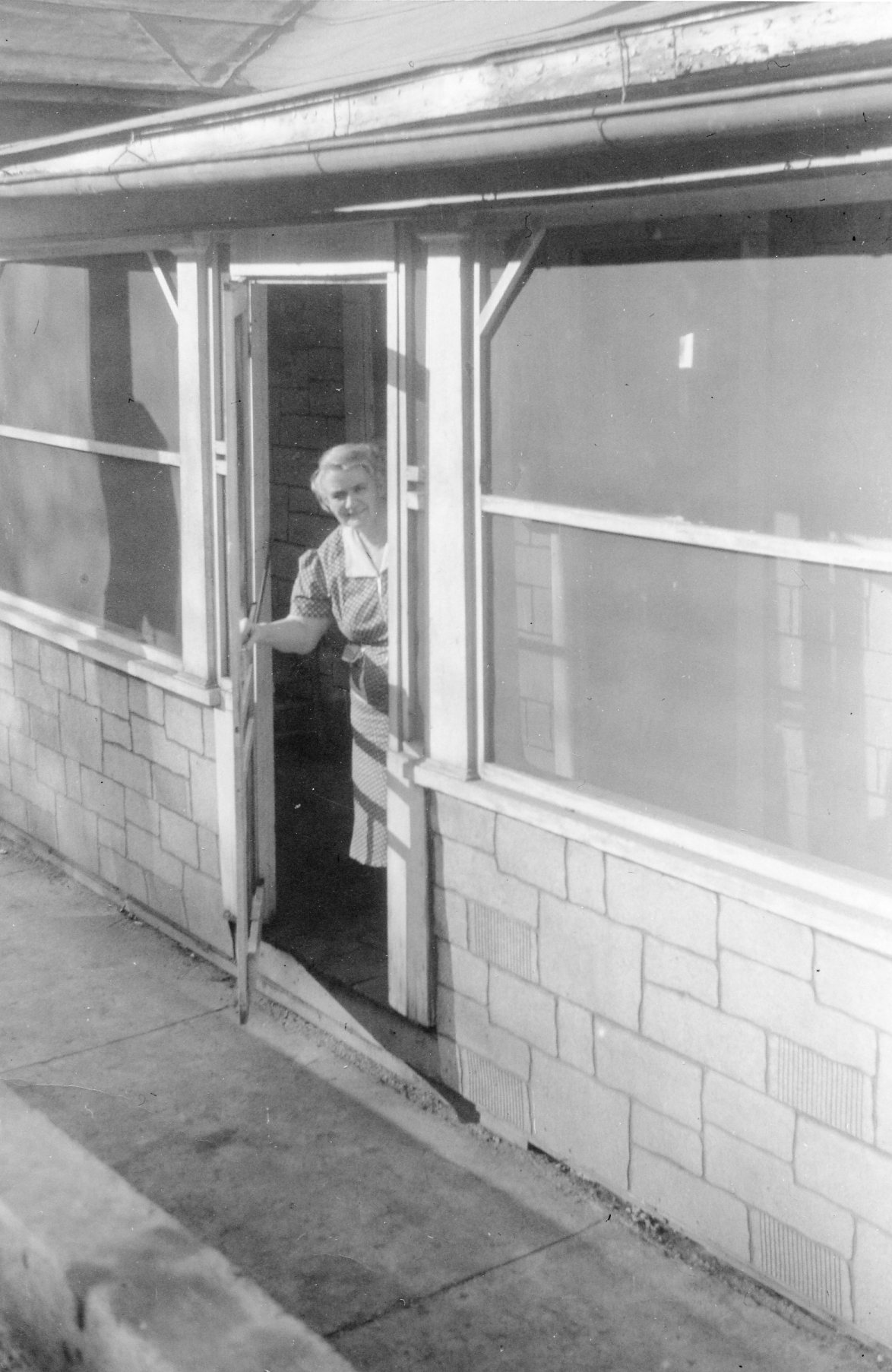
ImageMy grandmother, “Aunt Tet,” on the front porch of her house. She was housebound with severe arthritis, and so this was the outer boundary of her world. The unoccupied house fell in on the street side in 2010 and was removed by the city. 

My grandfather, Ivan Morgan, had been quite handsome as a young man, and in his seventies and eighties, when I knew him, he was still quite imposing. He had grown up on a farm in rural Augusta County, Virginia. Family lore has it that a vacillating fiancée had called off the wedding ceremony one too many times, and in response, he headed over the mountains–tantamount to disappearing in those days. He landed in a lumber camp near Richwood run by Patrick “P.J.” Norton, whose large family included many attractive daughters, one of whom, Teresa, became his bride on October 1, 1915.

ImageThe Cherry floods Oakford Ave circa 1915. The couple in the jalopy may be my grandfather and grandmother; I’ve never been able to confirm this. 

Although he had often worked outdoors, in his later years, he didn’t go out much–just to the corner store to get his cigarettes, or to the Moose Club to get the occasional shot of whiskey.

I remember him sitting in his favorite easy chair–nothing grand, by today’s standards, but perfect for him: comfortably padded, it rocked, allowing him to get out of the chair by pitching himself back and forth until he had enough “altitude” to stand.
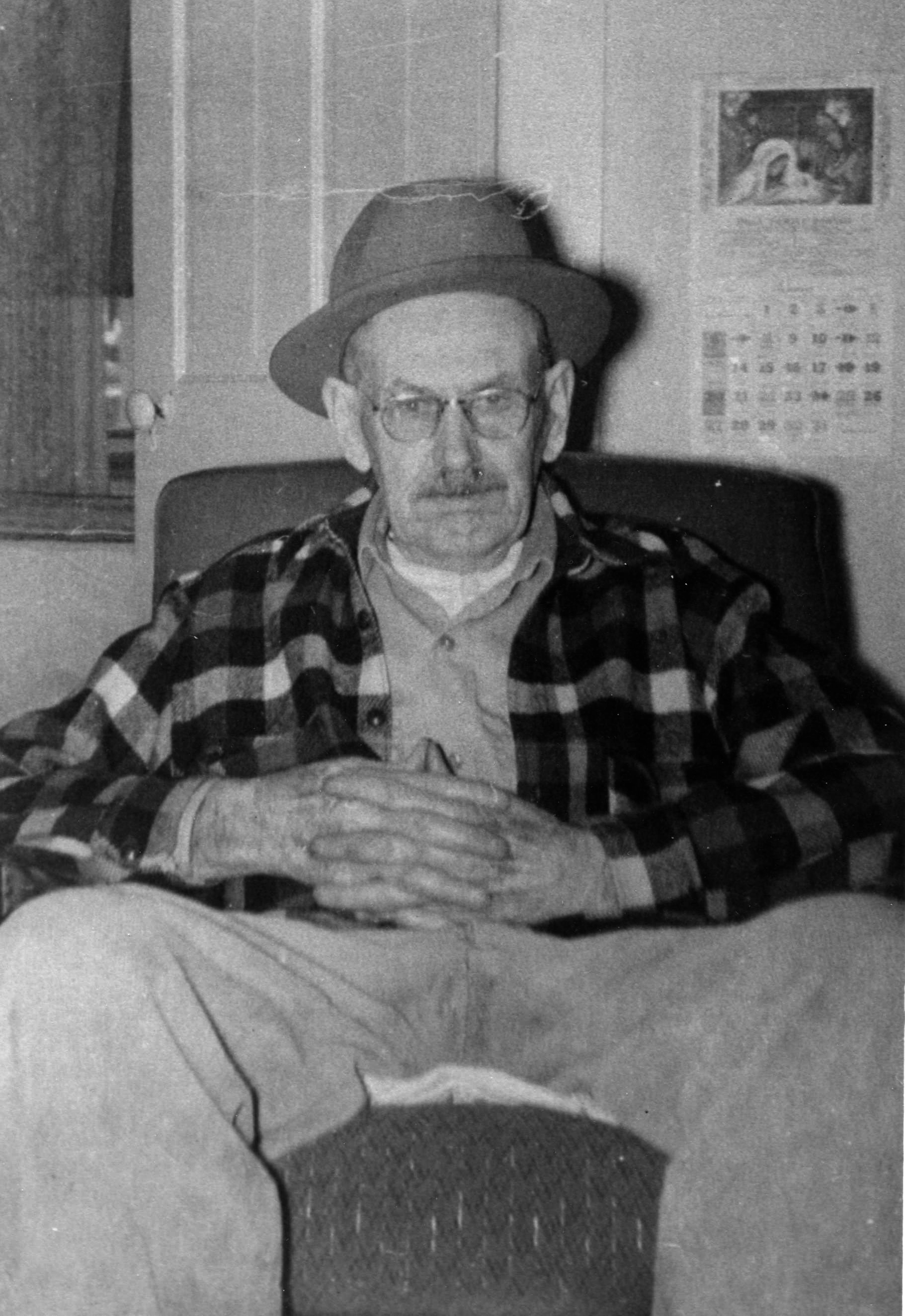
ImageGrandfather Hunter in his favorite chair

My grandfather had only been in school through the eighth grade, but he never seemed uneducated. He taught himself by reading, and there were many volumes of classics packed away in the “junk room” in the back of the house. He could recite long poems from memory. When I knew him, he mainly read the Charleston Gazette, which he would pore over using a large magnifying glass he kept on a wicker side table next to his chair.

The living room was sparely furnished. There was a sofa–they found one that was rather high so my grandmother, who was crippled with arthritis, could get in and out of it easily. There was a Philco TV, bought for my grandparents by the community. When I first started going there, there was a pot-bellied stove and coal scuttle that provided heat in winter, although that was eventually replaced by a gas stove. The outer rooms got cold.

There was a big, dark wood sideboard, a remnant of more prosperous times, which displayed mostly family pictures. My grandmother had a picture of the pope, Pius XII, in one of those dual perspective images that made it appear the pope’s arm moved in blessing you if you wagged the picture from side to side.ImageGrandma and grandpa Hunter with grandson Robert Perry Morgan. Note the palm frond from Palm Sunday draped over the picture in the upper left and the sideboard with family photos in the background.

When we visited, my father often went off visiting his friends in town, leaving my mother and me with Ivan and “Tet,” as my grandmother was universally known (a pet name derived from her given name, Teresa). I would spend many hours sitting across from him, as he sat ensconced in his favorite chair and related experiences drawn from his working life, which included road surveying and fire spotting for the forest service. For some period, he was even a manager at the tannery. It was the fire service job–the last he held–that provided most of the material for his story telling.

In this job, he spent his days in a fire tower, high atop Manning Knob, up the mountain from Richwood. He watched for the telltale smoke in the forested expanse that indicated a fire. He spent his nights in a small cabin at the base of the tower. He walked into town once a week to get his groceries, seven miles each way. This solitary life gave him a lot of time to reflect on his experiences.

ImageThe fire tower and cabin on Manning Knob. The tower was eventually torn down, and the cabin was moved about a quarter mile away across the road.

This reflection came out in his stories. They were not dramatic–they were often just brief vignettes or descriptions of experiences he’d had, or events or people he’d heard about. He told of things like a chestnut sapling he’d tried to rescue and a bear he’d encountered in the woods. One time he recited the entire watershed of the Cherry. He told of a man who froze to death in the woods; he told of a worker at the tannery who was operating a large overhead slicing machine that moved up and down to cut the leather into squares, who lost his forearms when he reached in to straighten the hides. He spoke with pride of a spring he had built near his fire tower.

The stories usually didn’t have any particular point, although there was often an implicit lesson. The man who froze to death, who had been found sitting against a tree, shouldn’t have gone out hunting in such cold weather. The story of the sapling was about the time he found new shoots growing out of the stump of a chestnut tree that had been killed by the blight. He thought it would help the shoots to grow if he cleared the underbrush away from them, but it actually just exposed them, and they died. Shouldn’t have done that.

Sitting there, I absorbed the arc of narrative–how to choose the story elements for maximum effect; what must be included, and in what order, so the listener will understand the story; how to add telling details to draw in the listener; how to wrap it all up in a conclusion that conveyed the import of what had just been heard.

This ability to create a compelling narrative is something I use every day in my professional life, when I write a news release or the script for a documentary. Some of the most enduring and important aspects of my own education happened early on, in that house on the banks of the Cherry.

–Joe Hunter (grandson)


Posted in Uncategorized | 19 Comments

Mood-enhancing Classical Music—Beyond the Usual Suspects

We recently took a vacation to the Bahamas. This was in the month of February, when the weather here in Boston was still gray and bone chilling. I carefully planned the music I would take on the trip—I had already scoped out the palm tree I wanted to lie under from a photo of the pool and beach area on the website of the British Colonial Hilton, where we had booked our stay. I wanted music that would fit in with the sunny, tropical setting of the islands. I wanted music that would lift my spirits and dissipate all the wintry gloom of Boston.

From my iTunes library, I assembled a playlist I called, simply, “Bahamas.” I searched for pieces that went beyond the usual “most relaxing” programming, which has been repeated on countless CDs, e.g., the Romanza from Mozart’s Eine Kleine Nachtmusik and andante from the “Elvira Madigan” concerto; the Meditation from Thaïs; the Air on a G string, etc. As beautiful as those pieces are, they are overdone. They wouldn’t serve my purpose.

Instead, my anti-gloom playlist included a lot of pastoral English music by Vaughn Williams, Butterworth and Parry. I included the two English idylls of George Butterworth, along with his evocative Banks of Green Willow; Parry’s Lady Radnor’s Suite; and Vaughn Williams’ The Lark Ascending (admittedly, an over-anthologized “relaxing” work, but an evergreen for me).

There is a large dollop of Schumann, including the complete Kinderszenen and other solo piano works, such as the slow movement of the Fantasie in C. Also included are the slow movements from the four symphonies of this allegedly bi-polar composer—though these are bittersweet in tone, they offer a kind of ecstatic music that lifts you into a realm of passion and transcendence.

The slow movements of Mendelssohn’s two solo piano concertos are there, and the slow movement from Mozart’s Piano Concerto No. 17. Chopin makes an appearance with the slow movement of the Piano Sonata No. 3 and the Nocturne in D flat (Artur Rubenstein’s performance), which always makes me think of a sunset on a beach for some reason.

I couldn’t leave off Schubert, of course, whose Impromptu in G flat reminds me of a rushing mountain stream. The lovely slow movement from the Schubert’s Piano Trio No. 1 is there, too. The waltz from Tchaikovsky’s Serenade for Strings is included, as well as Pachelbel’s Canon; I couldn’t completely avoid the “most relaxing” warhorses, after all.

Posted in Classical Music | Tagged , , | Leave a comment

Women Composers

When I put together my list of the greatest composers—all male—I promised to take a look at women composers. Here is the fulfillment of that promise.

Not being a scholar or musicologist, I’ve contacted two women recognized for their performing or composing activities: Virginia Eskin, a pianist and lecturer known for her long time championing of women composers; and Diana Dabby, a pianist, composer and professor of music and electrical engineering at Olin College.

The Norton/Grove Dictionary of Women Composers has entries on 875 women composers in the western classical tradition. If you Google “women composers,” you can easily come up with websites that list hundreds, if not thousands, more. Sadly, none of them wrote works that come up to the level of the acclaimed (male) masters.

Given the cultural and social forces working against women, this is no surprise, says Eskin.

“Women haven’t been encouraged or allowed to compose, so greatness isn’t in the equation,” says Eskin. “Rather, you have to go step by step and look at each woman on her merits, realizing it’s a miracle she did it at all!”

The “big four” women composers who have reached some level of public awareness are Clara Schumann, wife of Robert, Fanny Mendelssohn-Hensel, sister of Felix, Hildegard of Bingen, the medieval abbess and mystic, and Amy Beach, the renowned pianist and composer of the late 19th and first half of the 20th century.

The case of Clara Schumann is instructive. Groomed by her father to become a virtuoso, she was a pianist and composer with an international reputation when she married the relatively unknown Robert Schumann in 1840. Norton/Grove comments that “his work took priority over hers, and for many years her composing and practicing were relegated to hours when her husband would not be disturbed.”

Eskin notes that Clara “was too busy tending to Robert” to pay attention to her own career. She left some poignant works, though, that are “flawed, full of beauty and full of palpitations.”

Eskin asserts the situation has improved for women in the modern era, both as composers and performers.

“Living women are much better off—and it’s looking better all the time,” she says.

Dabby feels the same way. “There are many more opportunities for women musicians and composers,” says Dabby. “If you look at many of the U.S. symphony orchestras, you’ll see about 40 – 50 percent women.”

I asked Eskin and Dabby to help me identify women composers, living and dead, whose works deserve attention.

Eskin points to Kaija Saariaho, a Finnish composer of electronic music born in 1952, who is receiving top-level commissions and concert performances of her works. She also singles out American composer and violinist Ellen Zwilich, who in 1983 became the first woman to receive the Pulitzer Prize in music.

Eskin calls Jennifer Higdon, born in Brooklyn in 1962, a “stand out.” Her Violin Concerto, also a Pulitzer winner, was written in collaboration with the violinist Hillary Hahn, who has released a recording of it paired with the Tchaikovsky concerto on the Deutsche Grammophon label.

Eskin also respects Gabriela Frank, born in 1972, and Dalit Warshaw, who is on the composition faculty at the Boston Conservatory.

Dabby believes Lili Boulanger should be better known. Boulanger, whose older sister Nadia became a mentor to many 20th Century composers, was plagued by disease much of her short life, but still managed to become the first woman to win the prestigious Prix de Rome in 1913 with her cantata Faust et Hélène.

Eskin recently released a disk of the works of Vitezslava Kapralova, a Czech composer whose brief life was framed by the two world wars.

Here’s a listing of the chief works of several other women composers mentioned in this blog:

Saariaho: Many of her works combine traditional instruments with tape or electronics, including Verblendungen for orchestra and tape, Jardin secret II for harpsichord and tape and Nymphea for string quartet and live electronics (written for the Kronos Quartet). The Finnish label Ondine has released a recording of several of her works, including Nymphea, in performances by the Los Angeles Philharmonic and the Kronos Quartet.

Zwilich: She has written several symphonies and concertos, as well as numerous choral and chamber works. Amazon lists quite a few recordings, including a disk of concertos on the Koch International Classics label.

Boulanger: A strong Catholic, Boulanger wrote many sacred and secular choral pieces, including Du fond d l’abîme, based on a psalm, as well as chamber music and songs. Amazon also lists quite a few recordings for her, including a 1968 disk of the BBC Symphony Orchestra and Chorus conducted by her sister Nadia; it offers several of Lili’s works combined with the Faure Requiem. The disk commemorates the 50th anniversary of Lili’s death.

My two cents: two of my favorite women composer recordings are the complete piano works of Clara Schumann on the CPO label, with pianist Jozef De Beenhouwer, and Das Jahr (The Year), a cycle for piano by Fannie Mendelssohn-Hensel, performed by Sarah Rothenberg on Arabesque. Both are currently available.

One last note: as I write, it is Women’s History Month; many classical stations are featuring women composers all month. Check your local listings and tune in—literally and figuratively.

Posted in Classical Music | Tagged | 5 Comments

Greatest Composers: the Second Ten

[Note: the most recent postings appear at the top of the blog; to get to the beginning of the “greatest composers” series, start reading with “The Top Ten Greatest Composers,” further down.]

One advantage of my data-driven approach to identifying the greatest composers is that, having named the top 10, I have the statistics available to identify the “second ten” top composers. Here’s my list of composers 11 – 20, arranged alphabetically, with some explanation of how I arrived at this grouping:

Chopin
Copland
Dvorak
Mahler
Puccini
Schoenberg
Schumann
Shostakovich
Richard Strauss
Vivaldi
Wagner

There are 11 names here; I have included two composers at the bottom of the list numerically (Shostakovich and Vivaldi) who had identical scores.

A reminder, again, about my criteria; in brief, they were: 1) inherent quality of works; 2) scope of influence; 3) whether they wrote some widely recognized timeless classics; and 4) diversity of composing activity (diverse genres, forms, instruments). Composers were rated according to these criteria on a 1 – 5 scale.

The top of this second grouping is occupied by Dvorak, Schumann and Wagner (each had scores of 13). Parsing that out a bit, to show how the methodology works: I gave Dvorak a 4 for quality of works, a 2 for influence (he is a giant of the Romantic tradition, but influenced few after him), a 3 for recognized classics (after you get beyond the New World Symphony, there is little that has captured the popular imagination), and a 4 for diversity of works.

Schumann, by contrast, gets a 4 for quality, a 3 for influence (Mahler, for one, learned a lot from him), a 2 for the number of classics (most people probably couldn’t name a Schumann work) and a 4 for diversity of works (he wrote in almost all genres, and although he wrote only one opera, he has numerous choral and opera-like works, e.g., Scenes from Goethe’s Faust, Paradies und die Peri).

Wagner got a 4 for quality, a 4 for influence (his harmonic innovations and use of the leitmotiv were especially influential for later composers), 4 for recognized classics (numerous operas) but only a 1 for diversity of works (he has very few non-operatic works, including a symphony and the Siegfried Idyll).

Surprisingly (to me, anyway) Copland and Chopin ended up with the same numerical score (12); Chopin’s total was brought down by the lack of diversity of works, in terms of instrumentation.

People can quibble with my ratings—and I’m sure they will—but if so, I invite them to use my framework, or devise one of their own, and make their own ratings.

Posted in Classical Music | Tagged , | 4 Comments

Top Ten Greatest Composers, Part II

The envelope please! I’ve run the numbers, and come up with the top 10 composers of all time.

As a reminder, I restricted the pool of eligible composers to those active roughly between 1650 – 1950, and set up four criteria for judging. The criteria, in brief, were 1) inherent quality of works; 2) scope of influence; 3) whether they wrote some widely recognized timeless classics; and 4) diversity of composing activity (diverse genres, forms, instruments). I rated the composers according to these criteria on a scale from 1 to 5.

And the winners (in alphabetical order) are:

Bach
Beethoven
Brahms
Debussy
Handel
Haydn
Mendelssohn
Mozart
Schubert
Tchaikovsky

Although I said I wouldn’t rank them, I feel compelled to reveal that Beethoven is at the top of the list, Mozart second and Bach third.

A word about the scoring. A perfect score would have been 20. I gave Beethoven fives in quality, influence and individual classics, but four in diversity of works (he only wrote one opera)—thus, he missed the perfect score by one point; Mozart had fives in quality and diversity, but only fours in influence and classics (he certainly played a major role in “what’s next” in music, but wasn’t as influential as Beethoven on the 19th Century; beyond “Eine Kleine Nachtmusik” his individual works are not as well known in the popular mind as Beethoven’s.)

I was a little surprised that Tchaikovsky made the list; he did particularly well in quality and number of recognized classics; he scored low on influence (he was rather a dead end), but his high scores in other areas were enough to put him among the top 10.

In the immediate next tier (just one point below the cutoff for the top 10) were Dvorak, Schumann and Wagner. Sorry Vivaldi fans!

Posted in Classical Music | Tagged , | 4 Comments

The Top Ten Greatest Composers

Anthony Tommasini, the New York Times classical music critic, has just concluded an effort to identify the top composers of all time. I like the idea, and I would like to undertake a similar effort, based on my own methodology. I was educated as a humanist, but I currently work at an engineering school, where data and statistics are considered essential tools in decision making.

I propose identifying the top composers by applying four criteria to the search: 1) The inherent quality of the composer’s works, as measured by generally accepted indicators of quality such as originality, creativity, innovation, and artistry; 2) The extent to which the works influenced later composers and advanced Western music; and 3) the extent to which the composer wrote some individual great works that have become time-honored classics, and 4) the extent to which the composer wrote in a wide number of genres, instrumental formats and musical forms.

I propose to rate each composer under consideration on a 1 to 5 point scale against each of these criteria, with one being the lowest and five being the highest score.

Like Tommasini, I would like to limit the composers under consideration to those who wrote and were most active during the 300 years from about the mid-17th to the mid-20th Century.

You can see how some of these criteria will favor some composers, while other criteria may disadvantage those same composers. Chopin, for example, will score high on criteria 1 (inherent quality) and 3 (wrote works which have become classics), but poorly on criterion 4 (wrote in different genres), as he wrote almost exclusively for the piano.

I will choose the top ten from among a set of composers generally considered the greatest in each cultural and nationalistic tradition. My list: Bach, Barber, Bartok, Beethoven, Berg, Berlioz, Brahms, Britten, Bruckner, Chopin, Copland, Debussy, Dvorak, Faure, Gershwin, Grieg, Handel, Haydn, Ives, Liszt, Mahler, Mendelssohn, Mozart, Nielsen, Prokofiev, Puccini, Rachmaninov, Ravel, Schoenberg, Schubert, Schumann, Shostakovich, Sibelius, Richard Strauss, Stravinsky, Tchaikovsky, Vaughn Williams, Verdi, Vivaldi, and Wagner.

I realize that it’s dubious to think you could come up with an “objective” list of the top composers; any such list will be shot through with subjectivity. But everyone who considers this question must have some criteria for their choice. I’m just being explicit with mine.

In my next blog, I will apply these criteria and come up with my (unranked) list of the 10 greatest composers of all time. I invite others to come up with their own criteria and lists.

Incidentally, I realize there are no women on the master list of composers; there are myriad cultural and historical reasons why this is so. Still, there were some great women composers, whom I plan to explore at a later time.

Posted in Classical Music, Uncategorized | Tagged , | 2 Comments

Desert Island Recordings

What if I were shipwrecked on the proverbial desert island with a CD player, some solar power cells and the choice of 10 CDs or CD sets? What would I choose? The 10 selections below are my “desert island recordings.” These are different from a choice of the greatest works ever written; that would surely include Beethoven’s symphonies, for example. These are performances that I return to again and again as touchstones of high artistry and deep spirituality.

Beethoven: The Complete Piano Sonatas: Wilhelm Kempff

I got to know these originally back in the LP era. I bought the sonatas as individual records, mostly in the 1970s; Recorded in stereo in the mid-sixties, the sonatas are now available on Deutsche Grammophon in an 8 CD set. You may be able to find some better performances of individual works, but for me, as a whole, no other recording touches the intensity and depth of these well thought-out interpretations.

Beethoven: The Late String Quartets: The Lindsay Quartet

I like almost everything the Lindsays did, especially their Haydn recordings, but for me the pinnacle of their art was these recordings of the Beethoven late quartets. I prefer their older traversal of these works, the one originally recorded in the early 1980s in analog. I believe it is available now on Decca.

Beethoven: Symphony No. 9: Fritz Reiner, Chicago Symphony,

This was one of the first records I ever bought, and it has been a reference point for me ever since. In the original 2 LP set, it was coupled with the first symphony, providing an interesting overview of the development of Beethoven’s symphony writing. I return to this recording again and again for the unparalleled power with which it presents this narrative of the triumph of joy and humanity over chaos and pain.

Schubert: Sonata in B flat, D. 960, et. al: Arthur Rubenstein

I discovered this recording relatively recently. Schubert’s last sonata was also one of my first recordings, in a mono LP performed by Paul Badura Skoda. This performance has proved unmatched in its searching artistry, with Murray Perahia’s reading, in 2003 recordings of the last three Schubert sonatas, a close second. Perahia also deserves an honorable mention for his recording of the Impromptus, D. 899 and 935.

Schubert: Die Winterreise: Dietrich Fischer-Dieskau, Gerald Moore

I have to be careful listening to this recording, as moving as it is—it’s possible to get drawn too far into the spiritually desolate world of this spurned lover. I also value the Benjamin Britten/Peter Pears collaboration on this work, but the combo of Fischer-Dieskau and Moore is unbeatable.

Mozart: Requiem: Vienna Philharmonic, Herbert von Karajan, conductor

Another of my early record purchases was Karajan performing the Requiem, in a mid-sixties recording with the Berlin Philharmonic and a different cast of singers than my preferred recording. Karajan returned to this work several times between the mid-sixties and mid-1980s, but on balance I believe the best is the 1987 recording with the Vienna Philharmonic, the Vienna Singverein and soloists Anna Tomowa-Sintow, Helga Molinari, Vinson Cole and Paata Buchuladze.

Mozart: The Marriage of Figaro: Karl Boehm, Chorus and Orchestra of the German Opera, Berlin

My favorite Mozart opera—my favorite opera, period—with a perfect cast, including Dietrich Fischer-Dieskau as the count and the incomparable Gundula Janowitz as the countess.

Schumann: The Complete Symphonies: George Szell, Cleveland Orchestra

To me, these are perfectly played: the perfect balance of orchestral forces, perfect emphases, and perfect tempos. The early 1960s stereo recording, at least in my 1996 compilation, is quite good, giving a warm glow to the sound.

Mendelssohn: Quintets, Octet: Hausmusik London

The highlight for me is not the famous Octet, but the lesser-known Quintets. This set also includes a Quartet, so it is a good sampler of Mendelssohn’s chamber art, played by one of the leading “authentic” music groups.

Mahler: Symphony No. 10: Rattle, Berlin Philharmonic

My familiarity with Mahler’s Tenth goes all the way back to a Philadelphia Orchestra recording with Eugene Ormandy from the 1960s. Rattle’s recording opened my eyes again to this work, conceived around the same time as Mahler’s other autumnal works, the Ninth Symphony and Das Lied von der Erde. Incomparable…stunning.

So with my CDs, player and solar cells, I should be all set to survive, at least culturally and spiritually, on my remote island. Now if I can just get used to the taste of coconut milk.

I invite others to submit their lists.

Posted in Classical Music | Tagged | Leave a comment